Showing posts with label Middle School. Show all posts

Flexible Room Arrangements

When another teacher asked me if I minded teaching in a classroom with desks instead of tables, I immediately responded that I would love teaching with desks again. Desks offer so much flexibility for different arrangements to suite the learning situation.

We have moved desks around to create landforms, and simulate a court room. Some days the desks are in single rows, double rows, or groups of four. Some days the desks are wherever the students move them!

The ebb and flow of a classroom benefits greatly when you have the ability to move desks around, and the students enjoy the ability to work both independently in single rows, with a partner in double rows, and with a group of four. Having desks means they can chose these options and student choice is a main way I develop relationships with students.

Here we were working in self-selected groups. You can see how each period of students arranged the desks differently. Having a large classroom space helped as well, but even in smaller rooms, the flexibility of desks allows for great learning.


Formative Assessment Through Pictures

How do I assess learning when students are not strong readers and writers? With pictures and questions!

Not all students feel confident or comfortable with writing about their learning. That doesn't mean they aren't paying attention, nor learning. To help them be successful in the classroom, I have them share their learning with me via pictures and oral answers to questions. This also helps build trust between us when they know I am willing to meet them where they are at.


I actually like this method so much, that I routinely have students draw pictures to explain their learning. Whether they prefer to draw on paper or digitally, I find engagement is high, and learning is expressed.


Creating comic strips is another way for them to visually show me their ideas and learning.

Student Communication with Google Docs

As a district that uses the Google Suite of products in our classrooms, I have found many ways to capitalize on the ability to share documents with other people.

Students collaboratively work on assignments with each other, I can share a document template for them to work on, and I can communicate both with them and with families more easily. Hosting all our daily notes, assignments, and other resources on our Google Sites Classroom website helped keep everyone informed, provided a place for students to find work when they were absent, and allowed for review of information at any time.

It has also helped with individual student communication in a couple of ways. For a student with very limited English Language skills, I was able to use the translating tool in Google Docs to translate documents for her to read. She could also type responses in Spanish, and then I could translate them back to English. This tool helped bridge communication and build a relationship. By the end of the semester, she was comfortable saying short sentences to me in English, versus the one-word answers she previously used.

Another occasion presented itself where I was able to provide daily feedback on a student via a shared Google document.

Amongst the many learning styles we have in the classroom, we also have students with different learning abilities. Coupled with that are students with various disabilities who may have difficultly attending class.

One student in particular was having a hard time in class; each day exhibited a different behavior and attention span. Talking to the student at the end of each class, and speaking with the Special Education teacher and parents weren't making much of a difference.

Ultimately, the goal was to find a way to keep the student in the classroom despite the suggestion to do otherwise. Everyone agreed to try a behavior checklist that the student would bring to class each day. We wanted him to have that responsibility, but I also quickly saw that I needed a spot to write comments on the particulars of how the day went.

Using the checklist as a start, I created a Google Sheets file that I shared with the Special Education Teacher and parent. Each day, as the student and I completed his checklist, I duplicated the information on the spreadsheet and added in my comments. The student quickly came to enjoy having me do this, especially on the days he did well in class.


Pretty soon, the good days far outnumbered the not so good days, and everyone was kept informed as to how things were going. This communication tool was a real benefit to everyone involved and was even part of the re-evaluation meeting we had at the end of the school year.

For myself, I was really happy to see the positive impact it had on the student himself and our relationship in class. This relationship extended outside of class and he would stop by to see me each morning to find out what we were going to be doing - an added bonus as I think this helped prepare him for what to expect each day.


Role Playing

Anytime you can get the students out of their seats and moving is a win. Add in a role play with a story and you are doubling your chances they will remember the lesson! All students get a chance to participate and they really enjoy the movement, laughter and activity. They physically participate in the learning.

I especially like role plays that involve very little set up, and can be modified, stopped and started easily. Learning about the regions of Europe provides a great opportunity for role playing.

When you compare the United States to Europe, Europe has so many distinct cultures. Why is that? One reason is the landforms that separated people.

To role play this lesson, I introduced the topic of the many cultures.


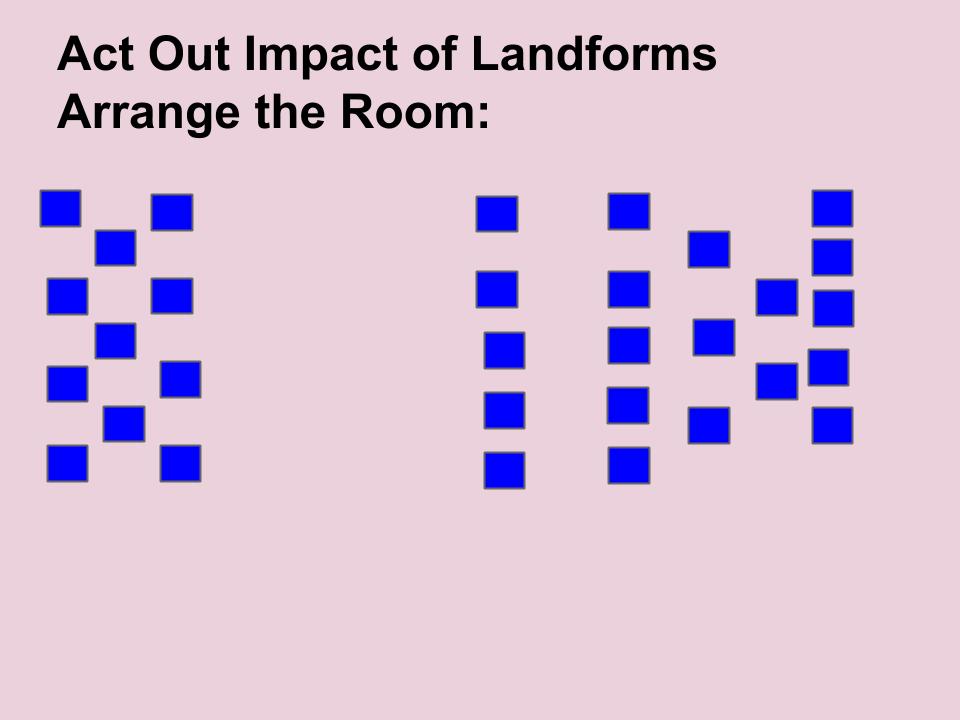
We then rearrange the room as such: 


The chairs are the Alps and the open spaces are the Danube River. 


Students sit on the floor on various sides of the mountains (desks) and move their way around the room on the river (floor) as I discuss trade, weather, ease of movement etc. 

In addition to physically learning about the isolation of some European cultures, we have a great time laughing and moving about the classroom. 

Reading With a Purpose

One of my go-to resources for Social Studies was Junior Scholastic. The magazine arrived monthly and always had articles relevant to what we were studying in the the classroom - both for Human Geography and United States History.

One article we read during our European Unit was about Surviving Kristallnacht.


The students read with a purpose: What was the author trying to get across to the reader. They had to give evidence and decide upon the viewpoint the author had about the topic, and what she used to get her viewpoint across. Here are the specific directions.

When studying Russia, we used a Sports Illustrated interview with the IOC president and a CNN article to learn about bias in writing. This is such an important skills to learn when reading and/or listening to current event stories in the news. Here are the specific directions.


Combining ELA Standards in Social Studies Curriculum

One of my goals as a Social Studies teacher was to integrate English Language Arts standards into the curriculum. We wrote argument essays, persuasive pieces, small moment writing and close reads.

When learning about the United States, we learned about reliable web resources and persuasive writing to write a letter to our parents persuading them to visit a certain state. The students researched their state's landforms and attractions, provided details about them, and created a picture collage for added persuasion.

To help them learn how to write persuasively, the assignment was scaffolding, each day adding another skill to learn. The final directions are here if you are interested. 

Image result for visit wisconsin

Students Helping Students

Whatever unit we are studying, an activity I do from time to time is have the students create a learning game for the rest of class. Whether it is Jeopardy questions, Kahoot questions, or matching games, the students work alone or together to create something.

When studying the United States, one thing is for sure, you will need to know the name and location of the 50 states. To help study for our test, one of the students made a game using Google Slides for his classmates to study from. I have posted the game below - but note that the animations don't work correctly when presented this way. You can get the jist of it though.


The Land of Opportunity


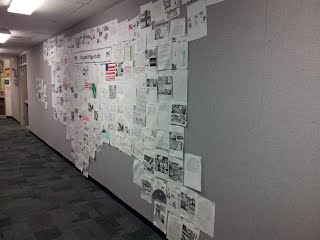
Before we began learning about other regions of the world, we discussed how America is seen as the Land of Opportunity and why. The students created their own version of what this means to them. We then created a map of the US to display our pictures and writings.

Not only was this a great way to culminate our learning about the United States, and compare the United States to other regions of the world, it was another way to allow student voice to come through in the classroom. Additionally, I learned a little bit more about each student as they created their document in the manner of their choice.


Map Reading Activities

As our 7th grade Social Studies curriculum focused on geography, we started the year learning to read maps. Below are some of the activities we did to learn about landforms, maps, latitude and longitude. We then culminated our learning by creating our own island and labeling landforms locations with latitude and longitude coordinates. Student's love the creative freedom involved and show great understanding of the topic.


I am a fan of the "so what" of what we are learning about, and therefore, the students had to explain how their landforms affected the people who live near them (something we had been learning about as well.)

While learning about landforms, I created a flipped lesson about them and used real paper maps - almost ancient history these days. Please see pictures of both below, including student responses to the video.

Flipped Learning

Flipped learning - what is that? According to the Flipped Learning Network website,

"What is Flipped Learning? Flipped Learning occurs when direct instruction is moved from the group teaching space to the individual learning environment. Class time is then used for higher order, active problem solving by students and one-to-one or small group interactions with the teacher"

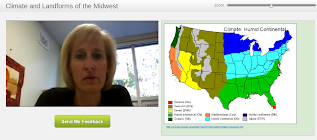
The reason I incorporate this in our classroom is to provide more class time to work with the information we are learning. Since this doesn't fit all learning styles, however, right now I am only doing one or two per unit. Here is our latest example:Climate and Landforms of the Midwest.


How do our students feel about this? Here are some of the comments they have left me:

"These videos are still awesome and it feels cool to LISTEN to your homework instead of reading it so nice job! ;)"

"I like it when you put these videos for homework. I like it because it lets us go at out own pace"

"These are a very good way to doing it. Instead of sharing this in class, just put it on the website! Its perfect."

"I really like taking notes from videos like this. I like them because I can pause and go back into the video if I need to hear something again or if I need to write something down. I also like how you include pictures of what you are explaining about. Lastly, I like having notes in this format to study from! I think this is a great way to get notes done, homework done, and to study for a test!"

Using Maps

We have spent a lot of time using maps, large paper ones in class, maps at home, maps in our textbook. These maps tell us climate zones, directions, tourist attractions, animal habitats, economic zones and country borders. The maps we used at home included Google Maps, road maps and weather maps. Hopefully we can all appreciate the use of maps outside of Social Studies class!


The "So What" of What We Are Learning

For both my Social Studies class and my current Business Law class, I want the students to see the connection between what we are learning and how it impacts many different facets of life. We discussed it, took notes on it, reviewed it, and ultimately tested on it.

For Business Law, we analyze each topic and how it impacts the government, citizens/consumers, businesses/artists, and employees. For each group of people, the students need to state the impact and then explain it.

For Social Studies classes, we discussed the impact of the topic on the government, economy, environment, and foreign affairs. Since I taught both 7th and 8th grade Social Studies to the same students, we were able to carry this concept through both years of studies.

A great introduction to this topic is the Star Wars movie. Yes, it too can be analyzed for impact on the government, economy, environment, and foreign affairs. They could even 4 square their  summer break!

Almost every student is successful in identifying the correct connections, and explaining them as well. The 4 Square is embedded in the unit's daily work, so we discuss it almost daily. Additionally, this format gives us a consistent way to organize information from unit to unit, which benefits student learning.

Here is an example of some of the 4 squares we created in 7th grade geography. Note: it does not include the explanations.


Real Life Decision Making and an Argument Essay

A lot of what we learn in class does not directly impact the students or someone they know. There were two instances when current events had a direct impact on someone they knew. One was the civil unrest in Syria as we had a Syrian family with relatives there. The mom came to talk to me about the horrors going on, and asked me to make sure we discussed the positive things about the people in that country as well as the negativity in the news - which we did.

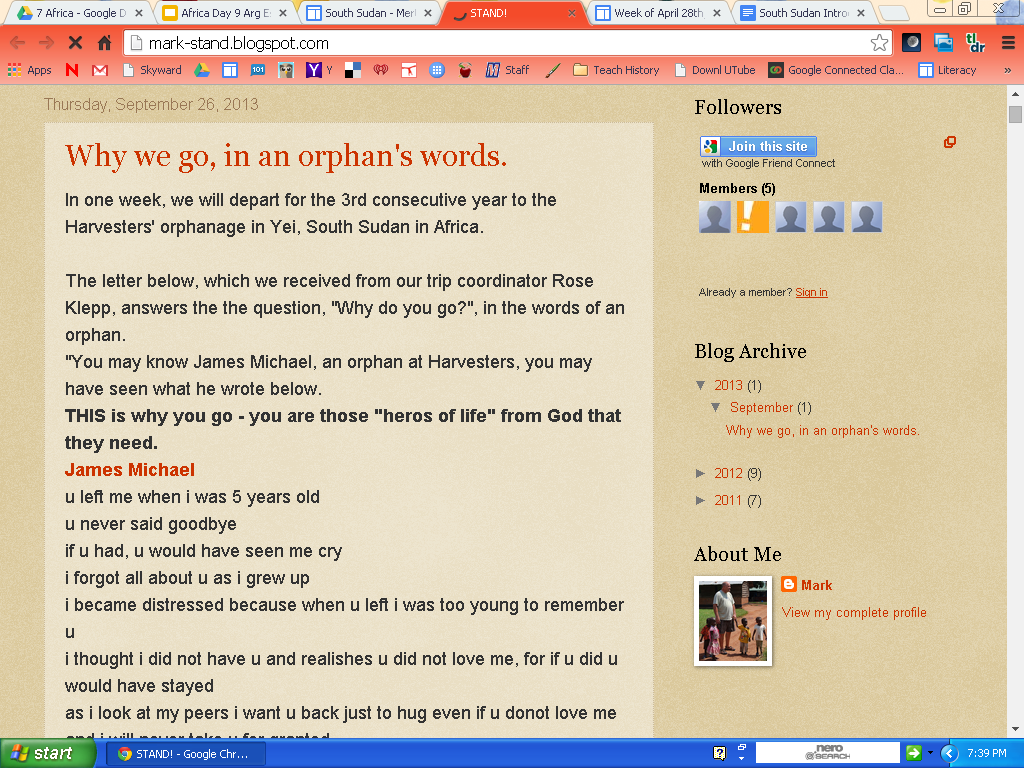
A second situation involved our former Superintendent. He had been doing mission work in South Sudan for a few years, and was debating returning for another visit. However, the political climate there was uncertain as well. Since all the students knew him well being that it was a very small school district, we spent two weeks learning about South Sudan and the civil unrest going on, learning about his mission work and how it benefited the people there, reading his blog and inviting him in for a visit.


Throughout all of this, students took notes with the essential question in mind: should he return for another trip.

All year we had been learning how to write argument essays, and this was another perfect opportunity for them to practice their writing with a real-life situation on the balance. While we had done meaty outlines of argument writing, we hadn't fully fleshed one out and this gave us a good chance to do so.

We moved through the steps of research, writing an introduction, using text evidence, deciding on a thesis and organizing information, transition sentences, body paragraphs, counter arguments, and conclusions. We did peer editing and sent them on to the superintendent to help him make a choice.

He did ultimately return to his mission work in South Sudan, though I believe it was a year later after things had settled down. In the end, the students took part in real-life decision making.


Book Connections


In Middle School, I loved the fact that each student had an independent reading book for Language Arts class, or at least had a book they were reading in Language Arts class. That meant I could require they bring a book to class. While this was helpful for "I'm finished" time, it was also a way to help make connections between our current unit of study and other situations.

What kind of questions did I have the students answer to make connections? Here are a few examples. Some were easier than others to answers, and some really took some stretching. In one case, the student's parent even emailed me. It turns out the character never left her bedroom, so how could she experience her environment? We improvised and had the student write about the environment of her bedroom, or what she saw out the window.

Sample questions and unit in discussion:

United States Economics
  1. Find an example of economics in your book and explain it.
  2. Analyze this example for how it affects the character - explain.
  3. Is this a positive or negative impact on the character? Explain
  4. How will this affect the character’s future? Explain

Europe (which has had many different types of governments over the years):
  1. Explain how government/rules affects your character(s)
  2. Is this positive or negative? Explain
  3. If your character could change something about this, what would they change and why?
India Caste System
  1. Are the characters in your book rich or poor? How do you know? Give details
  2. Explain and examine: How can you be rich without money? What do most people think?
Africa - Decision Making (Our Superintendent was planning to do mission work in Sudan and we were discussing if he should go or not given the political climate there.)
  1. In your book, find a situation where a character has to make a decision. 
  2. Explain the plot that is going on around this situation and what decision they need to make.
  3. Tell me about the character involved, what is their role in your story?
  4. How do they make their decision? What steps do they take?
  5. Could you have predicted the decision they make based on past events or your character’s motivations? If so, explain, if not, explain.

Analyze a Picture

One of the critical thinking activities I enjoy using is analyzing a picture. There are pictures to match just about any unit you are studying.

Europe has many forms of government, and I wanted the students to think about the "so what" in regard to governments. What do governments do for us, how do they affect our daily lives?

Here is the teaching picture I used in class:


Here is an example of student's work for this assignment. You'll notice that we are using a shared Google Slide Show. I like the ability to put this out for students to edit and combine their work. Once everyone has finished their part, the rest of the class benefits from increased view points. We use it not only to show learning, but to record inquiry as well.


Symbaloo - Easy Way to Share Classroom Links

I loved the ability to share all our classroom links on one page, and Symbaloo offers a visually appealing, easy to use format for doing so. Students can quickly find links. Because I posted many links in the daily notes section of our class website, I used Symbaloo for links that we would use more often, so the students did not have to scroll backwards through the daily notes.

Here is the live link if you would like to use some of these resources.

Flipped Classroom Lesson Example

In order to create more time in the classroom for learner-centered activities, once in awhile I like to post a "lecture" lesson as homework - sometimes called a flipped lesson. For this lesson, I have used some sort of Web 2.0 technology to record my lesson, and have then posted it to our class website or Google Classroom depending on which is available for our class.

The students access the directions and link, and take notes as instructed. This offers a great opportunity for them to pause and review the video as desired. No need to try and keep up with the teacher. It also freed up class time to work more in depth with the information presented.

Not all students, however, have the time to do this at home due to activity schedules and family responsibilities, or internet access. To accommodate those students, I build in time during the week where they can access it and takes notes in class.

Below is what they see on our class website, here is a link to the video. 

Taking Risks

We want our students to take risks, yet are we as teachers willing to take risks? This was a question set forth on Twitter one day and our principal challenged us to accept.

If we want our students to take risks, calculated or not, we as teachers really need to learn to take them as well. I rose to the challenge and decided my risk would be the chance of chaos, or it could be the chance for fun and learning.

The Civil War was a big risk for America and that also provided two great opportunities for me to add in some kinesthetic learning so to speak. I had already devised a team game for the entire unit. Each team would be part of the North or South. As their group completed activities, they earned points. Now I had a couple of groups who were not as motivated academically and almost always scored the lowest points. One day I brought in a tug-of-war rope from gym class and told them they could challenge any team they wanted, and the winning team would earn points.

Not only was this motivational for them, but really reinforced the tug-of-war between the North and the South for battles, land and freedom. It was so successful, that we kept the rope in the room for two weeks and any team could challenge any team. No, nothing broke, no one got hurt and we only disturbed one class once - the risk was worth it!


The second risk I took happened after reading Henry's Freedom Box - a picture book about a slave who mails himself north to freedom. We didn't have a box, but we did have the nice white cabinets you see in the picture above. The bottom right cabinet was a pretty good size, and we had a contest between the classes to see who could stuff as many people in the cabinet as possible. While loosely related to the book, it emphasized the tight quarters of slave ships and the sense of being stuck in a box for what seems like eternity. One of our students receiving special education services, who usually would not participate in anything, was so intrigued he had to try it himself, but by himself.

Which One Appeals to You Most?

For our Digital Learning Day challenge to try something new, I decided to have my 8th grade students create a Voki and then share them with a high school Social Media class in another city whose teacher I had connected with through our Business Education List-serv. To create a little excitement, I offered it out as a contest to my students explaining that the high school class would pick the Voki that met the requirements and appealed to them the most.

We were just beginning our unit on Photo Editing and I like to begin that unit with a discussion on the ethics of editing a photo that results in altering the truth. In the past, I would have my students write an email to a co-worker explaining the possible outcomes and consequences of altering the truth through photo editing, and persuading them not to do it. Using a Voki to communicate this message seemed like an engaging, yet still practical way to accomplish the same purpose. 


The students had a great time using Voki. Although they were all over thirteen, could create their own account, and I had notified all the parents we were using this website, I found out that we did not need to have an account to create a Voki (although they still need to be over thirteen). Once the Vokis were created, I sent all the links to the other teacher. He did a great job of using a Google Form to have his students answer questions about the effectiveness of the Voki, and then choose their favorite. I did all my grading prior to receiving these comments as I only wanted the high schoolers to provide authentic feedback to my students - an opinion other than mine as to the effectiveness of their message. Additionally, I hoped that the topic we covered added to the high school student's awareness of the ethics involved with photo editing. 


My students were eager to find out what the high school students thought of their Vokis and who the winner was. It was a neat experience for me to connect with another teacher and bounce ideas off of him, and we ended up being able to share some great resources on ethics with each other. In the end, both classes of students and both teachers gained from this experience. 

Strategies for Developing Independent Learners


If one were to Google "Developing Independent Learners", 2,450,000 results appear today, with the potential for even more in the future. Obviously this is an important topic in education and a goal of many schools. Since I teach computer classes, where the possible scenarios of what can happen on a computer are endless, I have found a couple of main areas that help my students become independent learners. One of our first grade teachers implements two of these strategies in his classroom and they are by far my most independent learners.


The first strategy is when a student asks a question, to respond back with "What have you already tried?" This strategy requires the student to problem solve as you are no longer going to quickly give them an answer. The second strategy is asking the students "Where can you find that answer?" By putting the responsibility back on them to find the answer, you have removed the cycle of the student always relying on the teacher for their learning. However, as a teacher, you need to make sure you have provided the students with the resources needed to find the answer. Possibilities include books, posters on the wall, directions on a piece of paper or the computer and other students. While I don't like to encourage too much reliance on other students as this shifts the responsibility off the student, it has been a proven resource. Diligent monitoring of the student's habits and timely intervention helps curb too much reliance on others. 

As a teacher, I also need to have routines in place so that students know what to do in certain situations (when they are done, when they are waiting for me) so that they stay focused on what they are doing.These strategies work in any grade. In my 8th grade class, the students don't like it, but I always ask them if they have read the directions when they ask me how to do something. If they have and are still confused, I follow up with "What have you tried so far?" and they we walk through it together. When they are done, I ask them what they should do and redirect them if needed. There are many other well-thought strategies to developing independent learners, but these are some of my go-tos.

Flipping a 6th Grade Math Class

My student teaching experience was an excellent experience for me as it afforded me the opportunity to work with a great teacher @jgbluedevil as we strived to provide the best possible learning opportunities for a group of struggling math learners. From the beginning, we collaborated on ideas to help the students and from there we laid the framework for a flipped classroom. The concept behind a flipped classroom is that the students watch an instructional video for homework and class time is spent on what would be traditionally considered homework. This allows for the teacher to spend class time working with the students instead of doing whole group instruction. This website is a great resource for information on teaching with a flipped classroom.


To begin with, we quit demonstrating problems from the workbook as the students would tend to tune us out and continue with other workbook problems, and we switched to notetaking. This is a process you need to teach the students, both how to take notes (write down steps with examples, not just random math problems all over your page) and then how to use the notes (leave them open on your desk as you do your math workbook). Using Flipsnack.com, I created a website where I posted these notes  along with links to online manipulatives, videos and also surveys for formative assessment. That way, if a student forgot to bring their notebook home or didn't understand their notes, they could access them at home. Additionally, the online manipulatives and videos provided extra reinforcement for the day's lesson.

Once we had established a routine of notetaking and helped the students become secure in using the notes, I created a screencast for one lesson. To scaffold the experience of a flipped classroom, we began on a day the students took a quiz. As they finished the quiz, they were to go to the website and watch the screencast video, then do two pages of their workbook. The video I created was also scaffolded to help them with the experience as I talked them through how to learn from a video. I told them when to stop and write something down and when to stop and do a practice problem. Students worked on this in class and then continued it at home. 


The next day, we corrected homework and all students who scored 80% or above on their homework worked independently to complete the remaining workbook pages in the lesson. The other students met with me for re-teaching. It turned out that over half of the students I met with were secure in the day's lesson, but had forgotten to simplify their fractions. The other half needed anywhere from five to fifteen minutes of individual teaching to become secure in the lesson. As they became secure, they independently worked on the remainder of their homework.


About a week after this experience, I surveyed the students about notetaking, notes posted on the website and the video lesson. The majority of the students felt it beneficial to have the notes posted online and half felt the video lesson was preferable to a lecture. Unfortunately, our school technology systems did not support the continuation of the flipped lesson. We had many difficulties finding a way to host the video in a manner that the students could consistently view it without errors occurring. Despite those problems, which we continue to work through, the students and I felt the lesson a success and one I would definitely continue to use.

Create a Story with QR Codes

During my 8th grade advertising unit, I wanted to incorporate QR codes. Always trying to avoid a lecture, and also always trying to include hands-on application, I created the following lesson with the end product being a story using QR codes. Here is my story, with details on the lesson at the end of this post. 


The students really enjoyed pulling out their phones and iPods (We are a BYOD school) to read QR codes that they found online and that they made. Of course they started out making silly ones, but then they also created some unique stories. The first limitation we had was that the more common QR code generators like Kaywa limit you to 250 characters, about two sentences per code. Then I found Delivr which allows 1500 characters. 

Our art teacher had the students use Delivr to do their author biographies and our gym teacher is planning on using QR codes to post instructional videos at each station. There are many curricular uses including creating notes and links to study for a science test, explaining how to solve a math problem and assembling a timeline for an event in history using text, links to pictures and links to videos. Since they are essentially a picture that can be saved, they can be posted in blogs, on Edmodo and Moodle, and as I did shared via many Web 2.0 tools. 

I tend to follow Bloom's Taxonomy when creating a lesson, so I began this lesson with the students doing individual research, replying to these questions with details in their own words: 

1. What is a QR Code?
2. Where are they found?
3. How are they used in advertising?
4. Compare/contrast them to a regular magazine ad or posted sign
5. Convince our principals that there are many helpful ways they can be used in the classroom (by students and teachers)
6. With a partner, learn how to create a QR code and use them to create a story. The story needs to have ten QR codes, seven with text and three of them being links to pictures. I also offered the option to work alone and only create seven codes, two of which were pictures.